> Kara Swisher Talks to Tim Cook about App Tracking Transparency, Privacy, and Security

Great conversation on the App Store and Security.

Apple’s stance on privacy is that it’s a basic human right and I couldn’t agree more. We have the right to privacy in our laws so why shouldn’t they be applied in our technology as well? Privacy is ingrained in Apple’s culture.

Steve Jobs in 2010:

Privacy means people know what they’re signing up for, in plain English and repeatedly I believe people are smart and some people want to share more data than other people do. Ask them. Ask them every time. Make them tell you to stop asking them if they get tired of your asking them. Let them know precisely what you’re going to do with their data,

App Tracking Transparency is clear and straightforward. It lets the user know they’re being tracked not just in an app, which in 2021 is always assumed, but when you leave the app as well. Asking my permission for something like that is simply the right thing to do. I mean imagine if someone from Macy’s literally followed you into a different clothing store. How creepy is that?

Facebook using small business as a human shield is pretty despicable. I’d be curious to see what the numbers in terms of revenue are now and what that are after ATT starts as I’m pretty sure the only ones really getting hurt here are Facebook.

> ▋

> Sony Might Sell More Consoles But They’re Still Competing Like Its 2004

Jason Schreier at Bloomberg:

Sony Corp.’s Visual Arts Service Group has long been the unsung hero of many hit PlayStation video games. The San Diego-based operation helps finish off games designed at other Sony-owned studios with animation, art or other content and development. But about three years ago, a handful of influential figures within the Visual Arts Service Group decided they wanted to have more creative control and lead game direction rather than being supporting actors on popular titles such as Spider-Man and Uncharted. Michael Mumbauer, who took over direction of the Visual Arts Service Group in 2007, recruited a group of about 30 developers, internally and from neighboring game studios, to form a new development unit within Sony. The idea was to expand upon some of the company’s most successful franchises and the team began working on a remake of the 2013 hit The Last of Us for the PlayStation 5. But Sony never fully acknowledged the team’s existence or gave them the funding and support needed to succeed in the highly competitive video game market, according to people involved. The studio never even got its own name. Instead, Sony moved ownership of the The Last of Us remake to its original creator, Naughty Dog, a Sony-owned studio behind many of the company’s best-selling games and an HBO television series in development.

Speaking as a consumer: I’m not sure how many people would want this. There’s no doubt that The Last of Us was a fantastic game and , I’m sure eventually, worthy of a remake. But the game came out so late in the Playstation 3’s life cycle that a remaster was released, literally, almost a year to the day later for the Playstation 4. While I’m sure it would’ve looked great this would’ve been seen as a cash grab by Sony, which it totally would’ve been. There’s literally no need for third remaster/remake for a game that came out only 8 years ago and already had a remaster done just 7 years ago. If anything, Sony needs to get its backwards compatibility act together. That remake in 2014 could’ve been completely avoided.

Speaking as a developer: Even if this wasn’t green lighted as a project it shows Mumbauer believes in his team and was willing to prove they’re more than a proverbial practice squad (to use NFL parlance). Even if it wound up not being more than a tech demo they could’ve found another title for them to remake.

For their first solo project, Mumbauer and his crew wanted to pitch something that would be well received by their bosses at Sony. Recognizing the risks and expense involved with developing a new game from scratch, they decided to focus on remaking older games for the new PlayStation 5. Remakes are considered a safe bet since it’s cheaper to update and polish an old game than it is to start from scratch, and they can be sold both to nostalgic old fans and curious new ones. The team originally planned on a remake of the first Uncharted game, released by Naughty Dog in 2007. That idea quickly fizzled because it would be expensive and require too much added design work. Instead, the team settled on a remake of Naughty Dog’s 2013 melancholic zombie hit, The Last of Us. At the time, Naughty Dog was in the thick of development on the sequel, The Last of Us Part II, which would introduce higher-fidelity graphics and new gameplay features. If Mumbauer’s crew remade the first game to have a similar look and feel, the two games could be packaged together for the PlayStation 5. In theory, this would be a less expensive proposition than remaking Uncharted, since The Last of Us was more modern and wouldn’t require too many gameplay overhauls. Then, once Mumbauer’s group had established itself, it could go on to remake the first Uncharted game and other titles down the road.

Uncharted is in desperate need of a remaster and it would potentially breathe new life into the series. I mean its old. Really old. 2007 old. It needs a fresh coat of paint. A remake might get people to play a Playstation exclusive that haven’t played it yet, selling more Playstations. Anyone who has might consider buying it for nostalgia and a prettier game.

Why not just get your backwards compatibility right and bundle them anyway using the PS4 version? If it’s one thing Microsoft is absolutely doing right with the Xbox consoles its backwards compatibility. Even more so with the One to Series X|S compatibility this generation. The whole backwards compatibility thing really is just Sony being greedy. These systems have the compute power to run emulation software and that’s exactly what Microsoft has been doing since the original Xbox One. If that machine can do it theres no reason a Playstation 4, and especially a 5, can’t.

But pivoting from doing finishing work for other games to making your own is difficult, since original development teams are “competing against hundreds of other teams from all over the world, with varying levels of experiences and successes,” said Dave Lang, founder of Iron Galaxy Studios, which has served as a support team and a development studio. “The people funding the work are often risk-averse, and if they have to pick between a team that’s done it before, and someone trying to do it on their own for the first time, I can see why some people pick the prior developer over the latter,” he said.

Sony is essentially taking a play right out of Nintendo’s playbook. Keep all your exclusives, quite literally, exclusive. While that works for Nintendo I’m not sure it works as well for Sony. Nintendo has beloved characters that became franchises. People associate Mario or Link with Nintendo and vice versa And while it would be great for gamers to be able to play their classic games on stuff other than Nintendo hardware, it would be seen as a loss for Nintendo. That their hardware just wasn’t good enough. I don’t quite get this sentiment for for any of Sony’s franchises. I dont think of Uncharted or God of War and think “Sony” or “Playstation” like I think of Nintendo when I think of Zelda or Mario or Metroid. Double for stuff like The Last of Us. If anything with those franchises I think of the developer first, not the hardware it runs on. Maybe part of that is that Nintendo is the developer as well as the platform. Almost all of those classic Nintendo titles were developed and published by Nintendo. Something Sony doesn’t seem to have. It seems like a lot of those old titles, like Twisted Metal and Warhawk from back in the day, were never developed directly by Sony even if they were published by Sony.

Microsoft however is treating things just a little differently. They still have their exclusivity but to a point. Where I can’t buy God of War or The Last Of Us on Steam, I absolutely can buy Halo. I can also buy it on the Microsoft store on my PC. Same with Gears of War. I can play them on my PC as well. They’re still exclusive in the sense that I can only play them on Microsoft owned platforms. Windows or Xbox but not Linux or macOS. Microsoft doesn’t need the Xbox in the way that Sony needs the Playstation. By taking this approach Microsoft is mitigating their risk. It lets them have multiple revenue streams on products allowing them to take chances on new things and smaller developers. If it doens’t work out at least theres a greater chance of return from more than one storefront. And what about backwards compatibility? All a developer has to do is modify the original game to work in the emulation software installed on every Xbox. This way every game is potentially backwards compatible and honestly it’s hard to think of one that isn’t from the Xbox 360 till now. Only original Xbox stuff is questionable.

At what point does this strategy run out on Sony? As long as the games and hardware stay competitive is my guess. It was when Nintendo’s hardware was no longer competitive that they fell behind Sony and Microsoft. It’s not to say that what they do is bad. They still sell millions of copies of games and the Switch is a huge success. Its just not a traditional under the TV console. Nintendo also got their backwards compatibility kinda right. The original Wii would play Gamecube games and the Wii U played Wii games but didn’t carry Gamecube compatibility forward. The virtualization that started on the Wii was carried to the Wii U and sorta continues on the Switch. Nintendo gets this. Microsoft gets this. Sony… not so much. It’s like they treat digital sales as if they’re just another type of media, like a disc or a cartridge, and thus, trying to keep it locked down to specific consoles, instead of the software it is. It’s like Sony is still trying to get you to buy CDs and MP3s when everyone else has made the move to Spotify. Eventually the “key studios” well is going to run dry. It’s literally impossible to produce a mega hit every time, even with experienced studios and massive funding. Eventually customers get sick of buying the same games over and over again. It’s like albums: after a while it doesn’t matter how much better it looks if it’s the exact same game every generation. At the very least Sony needs to let its smaller teams try new ideas. Nostalgia and exclusives are only going to carry a console so far.

> ▋

> Intel 11th Gen Reviews: This Thing Sucks

I’ve been looking at reviews for the 11th generation Intel CPUs all week. The reviews are not good. I’ve transcribed these where applicable but you really should go watch the videos.

Jay over at Jayz Two Cents comparing the Intel Core i9 11900k to the Ryzen 7 5800x. Some highlights:

When it comes to just straight up raw processing the 5800x is faster in pretty much every where it matters. However when you go to the IPC (instructions per clock) where we lock them at 4GHz, it’s kind of a sad story for Intel. Where although we saw an improvement in IPC where we locked them at the same frequency, the same memory speed …. Intel’s IPC improvement was not enough to make up for Ryzen’s latest IPC which is just absolutely phenomenal. And then the only thing that makes Intel even compete with the 5800x is the fact that it has a dominant core clock. We need to see a true improvement process from Intel before these … harping on Intel videos end.

Tough but fair. He’s also the nicest of the bunch where by nice I mean “chose his words carefully”.

Steve Burke at Gamer’s Nexus talking about a handful of chips in various videos. If you like numbers and charts like I do, this is your guy:

On the Core i7 11700K :

The 11700K at its current pricing… I’ts not particularly exciting. We think microcode might help in some places. The boosting behaviour is not strong enough. It doesn’t boost to a high enough frequency in some of these games to surpass the 10700K, which is sort of embarrassing. The CPU is not really in an advantageous position vs the 5800x if they’re close in price. At all. If they’re distant in price maybe there’s a conversation there. Overall the 11700K kind of seems like a wasted effort. But we said the same thing about the 10700K where its in this no man’s land. We said the same thing about the 5800x. You should just buy a 5600x instead for most scenarios. Or if you’re really going to be production heavy a 5900x.

On the Core i9 11900K :

In our 11600 K CPU review that’s already live we said we wanted Intel to put up a good fight. An entertaining one versus AMD. What we ended up with with he 11900K is a boxing match between Intel’s left glove and it’s right glove leaving us with one extremely confused parasite occupying the carcass of what was once a great and competitive host. And so we’re here to review the Intel i9 11900K. If the 11700K was a waste of sand that could have been on the beach, the 11900K might be a waste of sand that could’ve been in swimwear. It’s that bad.

Ouch.

On the Core i5 11600K vs the R5 5600x:

Rocket Lake looks to be sort of a stop gap solution. And it was certainly supposed to come out a lot longer ago than it actually did come out. And Alder Lake isn’t that far ahead at this point which makes buying Rocket lake, even if it’s in a competitive position, feel a little bit not great. Sort of like buying Kaby Lake when you got Coffee lake later that year.

I can somewhat agree with this. I don’t regret my 7700K as I’m not sure I would’ve gotten that much more out of an 8700K had I waited.

But let’s continue:

So looking at the power chart you have a part that does 60 something watts, that’s the 5600x, vs the 11600K which, following Intel guidance is about 125 watts for sustained load. So 120 vs 60 and yet the 5600x is in some cases murdering the 11600K in production or in best cases tied. The efficiency is just favoring the 5600x. Now that doesn’t necessarily matter for a gaming targeted product and a lot of people who are building more cost effective gaming rigs really dont care that much about an extra 60 watts here or there. So in gaming Intel now with the 11600K is in a significantly better position than it was maybe a month ago. … So now the 1600K is extremely competitive with the 5600x if you are planning to either specific or a lot of production workloads but don’t have the budget to step up to an R7 or R9 then the 5600x still makes more sense because in some applications like compression / decompression you’re anywhere form 13 to 22 percent better on a 5600x which is obscene. Or in something like Blender you’re roughly equal to an 11600K but more power efficient. Now if you’re primarily gaming … the 11600K … out of the box, it’s extremely competitive gaming, it’s cheaper, it ticks all the right boxes to be a value focused CPU.

This was essentially the case made when I bought my i7 7700K in… 2017. If you’re really just gaming, Intel is still great. Anything more and you should go AMD. Like I’ve mentioned before, in gaming rig land power efficiency is a feature not a requirement. It’s great the the Ryzen chip is 60 watts more efficient at load but what concerns me more are the thermals.

On the Core i5 11400 : vs the R5 3600, 5600x:

So this is where Intel now has it’s best chance. It’s at the lower end. The non-flagship territory. Where the i9 11900K goes forth to decimate itself, the 11600K and 11400 have a chance to price compete where AMD is missing right now. If you’re wiling to give up that flexibility of overclocking or you’re the type of person who doesn’t care about a couple percentage points or you don’t want to bother with overclocking anyway then the 11400 is a good consideration to save some money and get a relatively well positioned gaming processor where it’s not facing a lot of immediate competition. Overall the positioning is strong for gaming. It lacks some confidence in the production benchmarks so its a few places where the 11600K becomes more relevant than it might otherwise be vs the 11-4 as compared to games. An example might be photoshop where the higher boosting frequency, since its multiplied across all threads, or all cores at least, becomes tangibly noticeable in terms of the performance increase you get in certain applications like photoshop. If you’re planning to do any amount of pseudo professional or professional work that involves non-gaming applications that’s where those $300ish CPUs start to become more meaningful as an upgrade. In gaming for a lot of people looking at these price classes $100 up from the 11400 is a very large jump and that amount of money could be put into something else. Either you save it or you put it into the GPU. At which point now you can maybe play games at a higher resolution or whatever.

Between the 11600K and the 11400 I’m really starting to see a pattern here. Gaming is still good so long as price is competitive. Any other situation… not so good.

Hardware Unboxed comparing the 11600K and 11900K CPUs:

Core i5 11600K vs Ryzen 5 5600x and Core i5 10600K:

The new Core i5 11600 K when compared to the 10600K. It’s typically between 10% to 20% faster for productivity tasks, which is right in line with Intel’s own claims of a 20% IPC increase. It also meant for the most part it was able to keep up, even match the Ryzen 5 5600x. So Intel has made up some good ground ont he productivity front. Though as we saw int he Blender benchmark they’re nowhere near AMD in terms of efficiency and that’s down to the fact that they’re stuck on the 14 nanometer process node When it comes to gaming AMD is still on top. The Ryzen 5 5600x was 7% faster than the 11600K based on our ten game sample. Intel also only made a small 5% step here from the 10600K.

Each site is definitely using their own set of games for benchmarks and it shows in the numbers. Hardware Unboxed got somewhat different numbers than Gamer’s Nexus. The good thing is there is consistency where a middle of the pack chip is always somewhere in the middle of the pack. It only really varies depending on how old the game is and possibly what technologies that particular game is using. The variation in games between sites is good though. I tend to play more games that Hardware Unboxed tested with vs Gamer’s Nexus whereas someone else might lean the other way.

The Hardware Unboxed Core i9 11900K review :

At a list price of $540 US in thousand unit quantities and a current retail price of $615 US at places like Newegg, and no that’s not a third party listing, the new mainstream desktop Core i9 part… It’s a complete joke. So much so that I almost couldn’t be bothered reviewing it. Even at $540 US I just don’t even know why this thing even exists. Other than to take advantage od helpless Intel fanboys. I know that sounds harsh but you’ll understand where I’m coming from once we have a look at the benchmark graphs. Also worth keeping in ming is that the 12 core 24 thread Ryzen 9 5900x also costs $550 US … the performance deficit is going to get pretty ugly in most tests. That’s really the main issue with the Core i9 11900K. The price just doesn’t make sense. Like not even a little bit of sense and assuming good availability of both the 11900K and 5900x with both available at the MSRP there is quite literally no reason to buy the Intel offering. It’s objectively worse at everything and often much worse.

Brutal.

I think the big take away from all of this is simply that if you’re only looking to do gaming and little to nothing else, Intel is still a viable option so long as you keep it in the “value” price range. At around $200 for a CPU. Anything more than say $250 and it’s off to AMD land.

In terms of raw numbers the Core i9 11900K isn’t terrible, but it’s not the flagship product Intel wants it to be. It has decent performance but at it’s price point to say it’s just not a good chip is putting it kindly. It’s a jumbled mess of a product. It has less cores then its predecessor and competitor, barely keeps up with its predecessor, gets blown out most of the time by it’s competitor, and seemingly manages to use more power while doing so. Even as I sit here on a 7th gen Core i7 7700K, not a single one of these Intel chips justify an upgrade.

> ▋

> Hell Hath No Fury Like a Chipmaker Scorned

Most of us don’t normally care about ads. They come, they go, and most of the time they’re forgettable. Until one ad campaign comes along and for whatever it just sticks. Apple’s “Get a Mac” campaign is probably the best known ad campaigns in tech with “There’s an app for that” probably a very close second. The only other one that can even come close is “Dude, you’re getting a Dell” and even then, that’s pushing it. In fact, the “Get a Mac” ads were so successful that Microsoft responded with the “I’m a PC” campaign. Imagine that. Microsoft had to defend against the Mac in 2008. In fact, I’ve seen so few ads for Microsoft products, Xbox aside, in my entire life that I barely remembered these. Yes, these simple ads for the Mac were that effective. And here we are yet again with someone else trying to recreate that magic. This time it’s Intel with their “Go PC Justin Gets Real” campaign and, once again, it’s pretty bad.

While Apple is important to this story, this story isn’t really about Apple. But let’s start with Apple and a potted history of their relationship with Intel. About 15 years ago Windows and Intel were dominant in the desktop space. When it was finally decided in 2006 that the Power PC architecture wasn’t going to cut it anymore Apple made the switch to Intel processors. The intersting part about this is that even though the announcement itself was a big deal, and Apple did run exactly 1 ad saying Macs now had Intel processors. That was it. Never in the entire “Get a Mac” campaign did apple mention the fact that Intel chips were in Macs. At most they made mention of some of the benefits of them being there, such as being able to bootcamp Windows onto your Mac, but they never mentioned Intel directly. Apple also managed to keep Intel’s famous stickers off of Macs. When asked why they wouldn’t be sporting the stickers Jobs responds as only he could:

“What can I say? We like our own stickers better.”

Contrast this with today’s iPhone ads. At the end of every ad or somewhere on every billboard is a carrier logo. Apple still controls the advertising but the carriers get to put their version of an Intel sticker on the ad.

However Steve does follow up with a nugget of truth:

Don’t get me wrong. We love working with Intel. We’re very proud to ship Intel products in Macs. I mean, they are screamers. And combined with our operating system, we’ve really tuned them well together, so we’re really proud of that. It’s just that everyone knows we’re using Intel processors, and so I think putting a lot of stickers on the box is just redundant. We’d rather tell them about the product inside the box, and they know it’s got an Intel processor.

What Jobs says is to an extent true. Most Mac users aren’t going to care what’s in their Mac. Sure, Intel is well known and I’m sure that was a big boost, but I’d argue that the average Mac user doesn’t care what chip is in their Mac so long as its fast.1 Most Mac users araen’t buying Macs because of the brand of chip in them, they’re buying Macs because they’re Macs. 2 I’d say that was true in 2006 (and Steve knew it) and it’s true in 2021 as Apple transitions to it’s own silicon. I’m sure at the time Apple was happy to cash in on the Intel name hoping it would push people on the fence to buy a new Mac. Intel was probably happy to simply sell more chips and now, essentially, dominate everything. AMD was absolutely a competitor back then, but definitely not at the level they are today. The irony here is that M1 Macs have been out for a few months now and I still havn’t seen a single ad for them. In fact, I cant even remember ever seeing an ad for AMD. Ever.

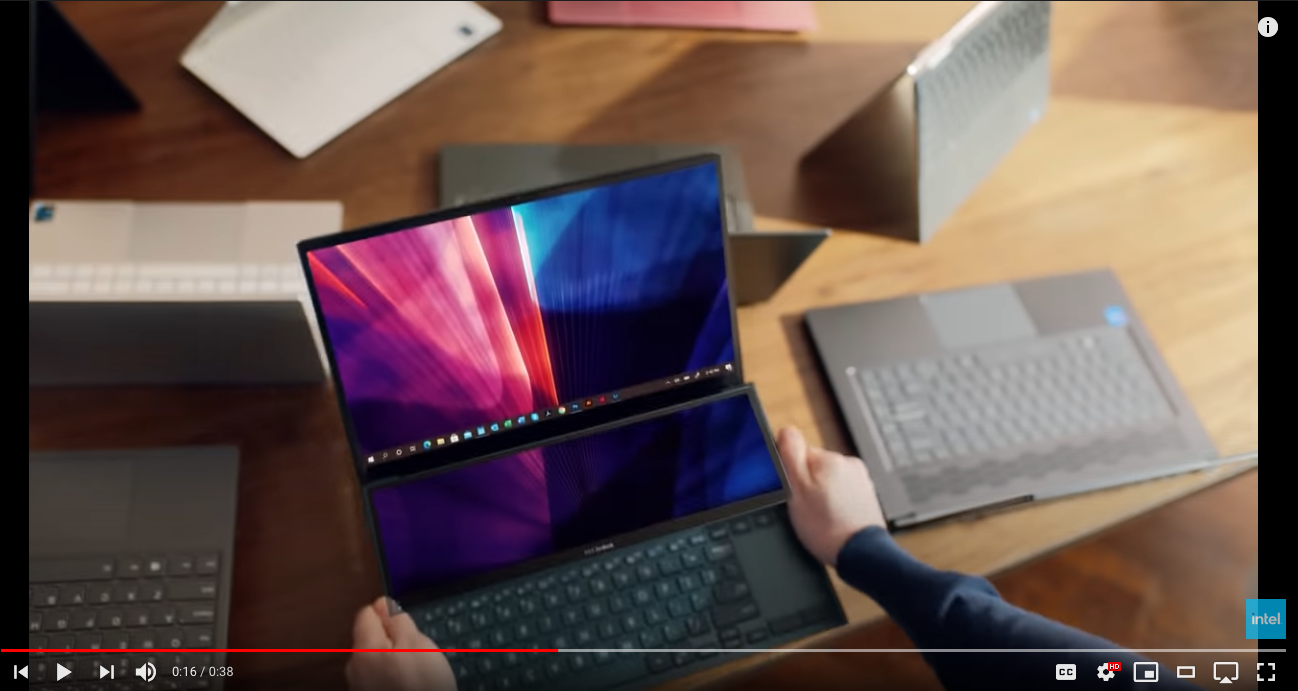
Intel’s ads start with Justin Long, previously our Mac, standing on a white background and introducing himself as if he’s about to rehash his old job and cuts himself short. He then goes on to say he’s “just a real person, doing a real comparison.” This is a marketing department’s bad attempt at parody and a media department that can’t even photoshop things right. Seriously, look at Justin’s thumbs.look at Justin's thumbs. Unless theres some new holographic technology I’ve missed this is bad a photoshop. Then the ads themselves go on to show various reason why a PC running Intel is better than a Mac. Sure there are valid points in these ads. Most them are the same tired talking points that PC makers have been using for years that come down to the differences in opinion that Apple and other PC makers share. Apple believes touch shouldn’t be on a laptop. Apple doesn’t believe in convertibles. Apple could put MacOS on an iPad but why? After seeing the problems Windows has on ARM I wouldn’t want to force that either.3 Macs don’t unlock via Face ID. This is on Apple and I believe that Intel was a limiting factor in that and they wanted to hold their cards close knowing this change was coming sooner rather than later.4 And then there’s the one about gaming…
Right now Intel is fighting a war on two fronts, which is never a good thing. First it’s currently having issues in the consumer space where it’s being challenged by Apple and the M1 chip. The M1 is beating Intel not just in pure clock speed but also in two things that are incredibly important in low to midrange computers5, like the ones shown in the ads: thermals and power draw. For a direct comparison take a look at this comparison between not just the M1 chip currently but the older Intel Mac Minis. I’m writing this on the 2018 Mac Mini shown in the chart. The M1 can run with less power draw than my previous 2011 Mac Mini with a dual core 2.3 GHz Core i5 but give me the the same if not more power than my 2018 i7. And then theres the thermals. These are the reasons why Apple left them. From day 1 I’ve noticed this 2018 Mac runs way hotter than my 2011. One of the things that made me fall in love with Macs was their utter silence. I’ve heard the fan in the 2018 Mac more times than I think I heard the one in my 2011 Mac’s entire life span. Even though the only thing I truly worry about are the thermals on my Mini, this matters way more when looking at laptops. More power draw means less battery life and hotter laptops. Hotter laptops mean fans kick up and sound like jet engines. While none of this is important enough for me to run out and replace my Mini. However if I had to replace my 2013 Macbook Air sporting a 1.3 GHz i5 with a current model, Intel or M1, Which one do you think it would just make more sense to go with? Certainly not Intel. Other than low hanging fruit, no pun intended, what really is the point in going at Apple? Apple is a subset of a market and M1 is barely a percentage of that market on top of it. This is Intel begging people who may not know better not to switch to M1. It’s defensive and for Intel, who is supposed to the best, it’s not a good look.

The second and arguably more important fight that Intel is in is on the PC enthusiast side of things where they are definitely losing to AMD right now. AMD isn’t exactly eating Intel’s lunch but they’re coming damn close. The balance lately has been that AMD was ahead in gaming but Intel still owned productivity. That gap is shrinking buy the day. Most of us enthusiasts could care less about power draw. Throw a 600 or 700 watt PSU down and be done with it. Most of us are gamers so we understand that powering all this hardware takes, well, power. Just keep it within reason. There is no need for a chip to draw excessive amounts of power for extended periods. That’s a problem. Lower draw in this space is a feature, not a requirement. We do however care about thermals. Our CPU needs to be cool enough that under load, or especially when gaming, it won’t down clock or burn up. Otherwise, we want straight, raw performance. For a while now AMD is been beating Intel there too. AMD has a higher instruction per clock, a smaller nanometer process, and as a result is able to do more with less cores. This to me seems like the more important fight. Let Microsoft continue to battle it out vs Apple. Have that fight via software. Intel needs to fight it’s fight against AMD for us enthusiasts. Right now Intel is barely keeping up. The initial reviews I’ve seen from sites that have been able to get 11th gen Intel chips early at retail (enabling them to go around the NDA from Intel) are not good. As in “this is worse than 10th gen” not good. As enthusiasts, we want raw power and right now AMD is the one giving it to us. That’s just talking about PC gaming. Look at the previous gen consoles: the Xbox One and Playstation 4? AMD chips. Xbox Series S|X and Playstation 5? AMD chips. AMD is clearly beating Intel in the gaming space. Intel still has a few saving graces though. The stability of an Intel system still can’t be beat. It’s quite literally the only reason I’d still consider an Intel chip over an AMD chip if I were buying today. Usually this is a no brainer and I’m happy to pay the “Intel tax” for it. Just know that given price to performance, that would be a very deep consideration. The only other thing it’s really got is brand recognition. A general consumer looking to buy a PC probably doesn’t know who AMD is. An IT department at a multi billion dollar cooperation probably isn’t going to mass order a bunch of AMD laptops either, at least not without those same considerations and a few test runs. However, if AMD can show they have the same stability as Intel and get their branding together they can easily put Intel in a very dire position. A cursory glance at Dell’s website shows they don’t even have to compete on price.

The problem with these ads is that this is essentially Intel screaming that they’re in trouble. Intel should be the market leader, and name recognition alone will only carry them so far. They have the brand recognition that only a few companies in tech have and that so many other companies would kill for. The Pentium jingle is forever ingrained in my memory. Intel Inside became a meme back in ancient times. When Apple partnered with Intel it was such a great moment since now it at least gave the Mac that extra bit of street cred it seemed to have been lacking because it wasn’t using an Intel chip. To make a go at Apple is incredibly short sighted. Naming Apple in these ads says “we are no longer the market leader”. Coke never mentions Pepsi. Microsoft rarely, if ever, mentions Apple. Saying that Intel is threatened by M1 is an understatement. They’re petrified of it. It’s everything a desktop class Intel chip is supposed to be with the power efficiency of a cell phone chip. What’s entirely wrong with this scenario is that Intel thinks they’re still Coke when in reality they’re Pepsi.

When incoming CEO Pat Gelsinger attended an all hands meeting for the company in mid January he said:

We have to deliver better products to the PC ecosystem than any possible thing that a lifestyle company in Cupertino” makes, Gelsinger reportedly told Intel employees. “We have to be that good, in the future.”

I took this as a rile the troops kind of moment. M1 Macs were beginning to be released and they were showing impressive numbers. So yeah, rile your troops. It’s what you do. Intel, like Apple, is at it’s best when it sees itself as the underdog. That scrappy “our stuff is the best and we’re going to prove it to you” mentality is where Intel really shines. That is when Intel really is the Intel that gave us the x86 architecture that started with the 8086 in 1978 and is still used today. The Intel that bec ame a household name. There is a marketing message here for Intel but these ads aren’t it. What Intel needs to do is take a step back and examine it’s core values. Especially now, with a key executive and former engineer returning to the company. It’s a very “Steve returns to Apple” kind of moment. Steve took a step back to simplify the product line and get it right. By doing so he rebuilt confidence in the Mac. While doing so he reiterated what Apple’s core values were as a company. Simplifying the product line and rebuilding confidence in their chips is what Intel needs focus on. Let your values guide you. I say this because I want Intel to succeed. I need a healthy, competitive CPU market that fosters innovation and keeps prices reasonable. What does that look like for Intel? I don’t know. All I know is that I want to feel the same way about buying an Intel chip that I do about buying an iPhone or a Mac: good.

> ▋


  1. The exceptions to this might be developers or professionals in any kind of media. The faster things render in final cut or Adobe stuff or compile in Xcode, the faster the work gets done. Literally. So yeah, to these people, specs, like Ghz, matter.  

  2. And I can tell you from personal experience that when I bought my first Mac in 2011, the chip inside didn’t matter. I was buying a Mac simply because it was a Mac. Not because it had an Intel chip. That was the last thing on my mind.  

  3. Yes, iPad OS is essentially MacOS at the kernel level but that’s not this conversation. Its not the full desktop version of MacOS.  

  4. iPads and iPhones have the secure enclave as part of Apple’s A series SoC. Mac laptops have the T series chip that controls the Touch Bar on certain MAc laptops. I fully believe this was a workaround for security because they were using Intel chips. Now that they have full control of the hardware stack I totally expect them to drop Face ID on Macs in the next year or so. They may even have the designs ready and just nede to time to fully figure out the manufacturing process.  

  5. I’m excluding things like gaming laptops here. I consider those high end and above. 

> Activision Finds Malware Inside Warzone Cheat

Lorenzo Franceschi-Bicchierai at Vice:

Security researchers at the gaming company published an in depth report about the malware on Wednesday, revealing the clever malware campaign. Activision security researchers found that a Warzone cheat advertised on popular cheating forums was actually malware that let hackers take control of the victims’ computers. The cheat installed a “dropper,” a type of malicious application that can be used to download and install other types of malware on the victim’s computer. “The dropper examined in this report, ‘Cod Dropper v0.1,’ can be customized to install other, more destructive, malware onto the targets’ machines,” the report reads.

I think it goes without saying that Malware is bad and I’m against it. That said: fuck ’em. If they’re dumb or desperate enough to cheat I don’t feel bad.

Many popular cheats require users to disable anti-virus programs and give the cheating software the highest security privileges on the cheater’s computer in order to remain undetected by anti-cheating software. This is a golden opportunity for malware, like the kind revealed in Activision’s report. With those security features disabled, cheaters might not see the red flags that warn them that the application they downloaded is actually malware. “When it comes down to it, the dependencies for a ‘genuine’ cheat to work are the same as those needed by most malware tools to successfully execute. System protections need to be bypassed or disabled, and privileges need to be escalated to allow the program to run correctly and/or establish persistence,” the Activision researchers wrote in the report. “While this method is rather simplistic, it is ultimately a social engineering technique that leverages the willingness of its target (players that want to cheat) to voluntarily lower their security protections and ignore warnings about running potentially malicious software.”

This reminds me of the situation we had last spring over Doom Eternal’s anti-cheat system. It wanted kernel level access to Windows. That level of access is reserved for the most fundamental parts of an operating system like basic input/output, CPU scheduling and system calls. It’s the part of the operating system that literally interacts with your hardware. Not a good thing and this was supposed to be the thing that prevented cheating.

I don’t know if Activision needs to go that far but they definitely need to do something before things like this end up affecting legitimate users.

> ▋

> The Ancient Gods Part 2: Rip and Tear Until It is Done. …And It Is Done.

I got to spend my Thursday night with the finale of Doom Eternal and I think it was really well done. Part 2 managed to maintain everything we love about Doom Eternal while giving us a big finish feeling. There really isn’t a whole lot to tell here as the DLC is pretty straight forward. The intro cutscene for the final set of levels just makes that final battle feel so big and epic. The difficulty was dialed way back from The Ancient Gods 1 and to be honest I’m not sure how I feel about that. I’m not a big Doom speed runner or out to get ultra nightmare but I’m going to assume this was the same difficulty as the base game. That said it took me essentially 6.5 to 7 hrs to comelete the dlc at the “Hurt Me Plenty” setting which is what I consider “normal” difficulty. This makes it feel short even though it seems like roughly the same amount of content as part 1, which took me over a week due to part 1’s difficulty. Perhaps they could’ve left the difficulty up just a little bit higher or made the arenas just a touch tougher and truly taken advantage of the Sentinel Hammer.

The grapple points were a great addition to being able to traverse the terrain. It’s one of those little things I found myself wondering why this wasn’t in the game from the beginning. I cant tell you how frustrated I was at times simply trying to climb things and get to places, only to fail because my timing or something was just a little bit off. This fixed that. It was one of those things where they could’ve left it alone and nobody would’ve complained but they went ahead and “fixed” it anyway. Well done id.

I do have a few complaints though. Small ones, but complaints none the less.

First is the Sentinel Hammer. While it is a cool item, I didn’t find it terribly useful. Maybe it was the difficulty I played on that I didn’t feel the need to use it often. Could be that the difficulty of Ancient Gods 1 prepped me incredibly well for part 2 and thus I didn’t need to use it, until I was essentially forced to. Maybe it’s a little of both. The few times I did use it, before I had to use it in the final battle with the Dark Lord, it didn’t feel… satisfying. It didn’t have that “oh my god this thing just saved my ass” feel to it. Maybe because it’s so easy to charge. Or it could be, because at least in my play through, there was an abundance of ammo for it which made trying to charge it pointless. It never had that “break glass in case of emergency I should hold onto this until I absolutely have to fucking use it” value to it since there was always ammo lying around for it. The only time I ever felt like it was rare was during my fight with the Dark Lord and he spawned heavy demons, but not the dogs to recharge it for long periods. It was only here that I held onto it’s charge because I was in fear of him giving me the opening to stun him and then not be able to follow up and inflict large chunks of damage on him. In the end it’s not that the hammer is a bad idea, it just felt unnecessary.

Which brings me to my second complaint: the final battle with the Dark Lord. It’s incredibly long and repetitive and feels more like a mid game boss fight than an epic “this is for all the marbles” endgame battle. There are about five or six levels to this fight that are all incredibly repetitive. The actual sequence itself isn’t hard as he’s essentially just a Marauder with “extra steps” ie: the Sentinel Hammer. The problem is that at no point didi the battle get intense. There was never really an “oh shit” moment. Through six phases, not once was I ever scared of him. Icon of Sin? Huge and fucking scary. Final fight for Ancient Gods Part 1? Shit this is going to be tough. Dark Lord? meh, I’ll just wait out his green flash and this should be over soon. The only thing even remotely difficult about him was the last phase where he drops in heavy demons from time to time that you have to clear out. Use the hammer and you’ll be fine, just hope he doesn’t give you the opening before you can charge the hammer again. Even though this is second on the list, it’s probably my biggest gripe. It just doesn’t feel like DOOM.

My last complaint is the ending cinematic. It’s very short. It’s great that it gets straight to the point, I just feel like it leaves a lot out. It does harken back to Doom 2016 and a clue is given at the beginning of your fight with the Dark Lord if you’re paying attention. The thing of it is, from a story perspective 1 it just felt rushed and thus unfulfilling. I understand the whole perpetual torment thing and that everything outside of Hell would be killed as they were all the Dark Lords creations and that this includes the Slayer. But just “telling” something with very little “show” doesn’t always work. Even though this ending does work, and I do like it because it is exactly what it should be, I would’ve appreciated something a bit.. bigger. Something that made fighting through Hell, almost literally in the case of Ancient Gods 1, rewarding. The thing is, it didn’t even have to be much. It really could’ve been just a few lines of dialogue explaining what was happening and why.

All in all I do think it’s a great end to a great story and a great bit of DLC. The combat never felt bad. There was only one potential bug that I experienced and I’m going to chalk that up to the pandemic as it was such a simple thing that probably would’ve been caught had they been in the office. The game looked beautiful and ran smooth. I know people are complaining about rehashing demons but this is par for the course with any DLC. Enemies get recycled, that’s just how it is. To be completely honest I wouldn’t have even cared if they recycled the Icon of Sin or something from Doom 2016 for the Dark Lord fight. The only downside really is the endgame. I probably would’ve have been disappointed less if either the Dark Lord fight or the ending had been bigger or just that bit more detailed. It’s just that to have the end fight be a Marauder with “extra steps” and then to have the ending itself be such a short scene, I just can’t help but wonder if this is the result of the team being up against the clock of the year 1 content pass with no way out.

> ▋


  1. I know I’m talking about story in a Doom game. Shame on me. 

> Ancient Gods Part 2 Drops Tomorrow

Was not expecting tomorrow. Next week, next month sure but not tomorrow.

My only hope with Part 2 is that they eased up on the difficulty some. Part 1 got to the point where, at times, it just wasn’t fun anymore. Finishing that felt like a life achievement.

BRB, I’ve got some downloading to do.

> ▋

> When Google Said they Wanted All the Data They Meant It

DuckDuckGo having a go at Google over the privacy labels in the App Store for Google’s Search and Chrome apps:

After months of stalling, Google finally revealed how much personal data they collect in Chrome and the Google app. No wonder they wanted to hide it. Spying on users has nothing to do with building a great web browser or search engine. We would know (our app is both in one).

You really have to go look at DuckDuckGo’s tweet to believe it. We all know we’re tracked, especially by Google and Facebook, but this is just incredible. To see it in such stark terms like this is just… Wow.

Firefox had a pretty fun tweet as well.

Given what the ones for Chrome, Search, Gmail, and YouTube look like so far I’m really curious / incredibly scared to see what the one for Google Maps is going to look like.

> ▋

> Inventor of the cassette, Lou Ottens, passes

“As the story goes, Lou was home one night trying to listen to a reel-to-reel recording when the loose tape began to unravel from its reel,” Zack Taylor, who directed the 2017 film “Cassette: A Documentary Mixtape,” said by email. Mr. Ottens was in charge of product development at the Philips plant in Hasselt, Belgium, at the time. “The next morning,” Mr. Taylor continued, “a frustrated Lou Ottens gathered the engineers and designers from the Philips audio division and insisted that they create something foolproof: The tape had to be enclosed, and the player had to fit in his jacket pocket.” The cassette was a way to play music in a portable fashion, something not easily done with vinyl, and to record it conveniently as well. Artists started using cassettes to record passing ideas. Bootleggers used them to record live concerts for the underground market. Young lovers used them to swap mixtapes of songs that expressed their feelings.

It’s not often that we stop to think about the small things that have huge impacts on our lives until something happens. This is one of those things and this is one of those times. It’s also amazing when these things happen and we find out the story as to why or how they were created. I can’t imagine life without cassettes and like most of the things that push our world forward they were created out of a frustration with the status quo.

Cassettes were such a huge part of my youth. Even though I had records as a small child, the very first music I owned was on a cassette. That continued well throughout my teens and maybe even into my early twenties. It’s how I collected music. Not just in the albums I bought, but with recording songs I loved from the radio. Later with dual cassette decks from tape to tape. If I remember correctly, my very first “adult” cassette was the Thompson Twins album “Into the Gap”. I was in the third grade and my grandparents bought it for me along with my very first boom box.

After that it was my first Sony Walkman and the rest is, well, history. Everything I owned until I hit highschool was most likely on cassette. Even though at that point I had started to buy some things on CDs, which Lou also helped create, the bulk of my listening was on cassettes because portable CD players were incredibly expensive at the time.

The thing I think I’ll always remember cassettes for though will always be the mix tape. Especially the ones we made for girlfriends or girls we were hoping to make our girlfriends. While playlists do carry a similar vibe, there was definitely an art to making a mix tape playlists just dont have.

The irony in all this is that a lot of my younger friends will probably have a similar reverence for their iPods, downloading MP3s to it, and making those playlists like my generation does for cassette tapes and the walkman. There is definitely a generational echo here.

> ▋

> Isn’t It A Little Early For COD 2021 Rumors?

What good fortune that on the very weekend someone wanted to start writing about games and technology, rumors begin to circulate about this year’s upcoming Call of Duty title. I really don’t want to get into rumors on my absolute very first post but here we are. That said, the fact that we’re getting rumors this early feels troubling. Usually we don’t start seeing any kind of rumor or even early info until March at the earliest. Ok, it’s the end of February so I guess we aren’t that early but it definitely feels ahead of the norm. Still, it really gives this feeling that maybe Cold War isn’t doing so well internally.

According to this tweet by Victor Z, a known and very credible leaker, COD 2021 is going to be another World War 2 game. At first I was curious as to why World War 2. I mean sure, it’s where the franchise started and Sledgehammers last outing there, while it wasn’t exactly loved, wasn’t hated either. While I appreciate that Sledgehammer tried a little something different with the regiments, it just didn’t work and really didn’t fit with the create a class system. At least not at first. I know WW2 got a massive overhaul at the midway point but by then it was too late. I know at that point I was already done with it and so were a lot of other people, to where most people don’t even know it was changed.

Something I’ve been thinking about as we move on with Warzone and these sort of soft reboots and one of the reasons why I think they chose to continue on with World War 2: Let each studio have their time period. Let each studio tell their own story as well as maintain their individual style via their own yearly titles while bringing them all into one big Call of Duty universe. Warzone will be the flagship product going forward while it also acts like a bit of a bridge to each of the sub franchises which is fantastic. I mean if you pause the Cold War Season 2 gameplay trailer at 1:47 that is unmistakably Price. Season 1 of Modern Warfare 2019 mentions gas canisters that look they could be a modern day Nova 6 variant and then they’re promptly dropped for the rest of the year. It was featured in the campaign as well, though they never gave it a proper name. Gas is not mentioned again until Cold War where so far it seems to be the main focus of the seasonal content. We’re only coming up to Season 2 so that may still change but it doesn’t seem likely. Given those things, World War 2 would fit in here perfectly. Part of me can’t help but wonder if they’re going to bring back characters like Kravchenko and Reznov from World At War. While I’m sure there will be a World War 2 centered campaign, I cant help but wonder if at least the Warzone stuff is going to focus around Nova 6. It would make sense to connect those dots as it would lead nicely into Black Ops 1. Part of me also cant help but wonder if this was the game that Sledgehammer was supposed to make this year but got pulled and how that would’ve impacted Cold War’s Warzone story.

I’m curious as to how they’re going to integrate World War 2 weapons into Warzone considering everything is modern or close to it. Cold War weapons are recent enough that they can compete and sit alongside current weapons from Modern Warfare 2019. Initially I was having a hard time imagining these weapons sitting alongside each other but it could work. While these weapons are old, some of them can definitely be viable. After all the AK-47 is in all three eras. The question, from a design perspective, becomes how do you differentiate the AK in Modern Warfare 2019 from the AK in Cold War from the new and definitely going to be different AK in World War 2 2021? Also where do you end up placing something like the M1 Garand? Most likely in the DMR category as it’s not strong enough to be a sniper rifle but it’s definitely does not fit in the assault rifle category. Raven definitely has their work cut out for them and it’ll be intereserting to see how they decide to integrate and balance these weapons.

From a technical standpoint I really hope they use the new engine that’s used for Modern Warfare 2019 and Warzone. Its just seemingly more efficient and optimized. I mean it has to be if its going to power Warzone right? I mean think about the memory allocation and things that have to go on to track a hundred and fifty players on a map with a huge draw distance. It has to know and even predict where it is a player might go, stream in those testures accordingly, and then increase or decrease the level of detail on the fly. Granted, the graphics parts are happening on each individual player’s end but the entire map must be loaded into memory for it to be accessed. And not just that, it has to track player states across the enire session. And it has to run on hardware as far back as the original Xbox one and Playstation 4. So yeah, I’d say it may be big but its optimized. Warzone aside, to be completely honest, it’s just prettier as well. The engine uses modern lighting techniques that Cold War’s either just can’t do, or doesn’t do well. I mean look at the “god rays” in the Modern Warfare campaign. Or the reflections on the weapons in multiplayer, just to name some of the more obvious things. I mean the game is constantly running in infrared so that you can use night vision goggles whenever you want. All these things are rendered in real time. Cold War doesn’t seem to do that and while Cold War doesn’t necessarily look bad, its lack of these techniques makes it look… old. Dated. Even still, some of the textures look great. It’s not a bad looking game for the most part. And then there’s the issue of frames. In Modern Warfare I easily get 100 to 150 frames a second. Where as in Cold War, even with medium textures and things dialed back, I’m lucky to break 100 and then the game really starts to look bad. And we’re talking about an i7 7700k with a 2070 super. This is not exactly low end stuff. For reference this machine rocks Doom Eternal at max settings and maintains ~250 FPS. While Doom doesn’t have Ray Tracing at all, there is probably more happening on screen in Doom than there is any Call of Duty title, ever.

It just seems like Teryarch refuses to use the modern engines and upgrade along side Infinity Ward. When they do use the newest tech, their games are fine. They look and run great. The problem here is that they’ve basically been “highly modifying” the IW Engine since World At War, which used the original Modern Warfare’s IW 3 engine from 2007. In reality there’s nothing wrong with this in talented hands. After all, IW Engine is built on id Tech 3. Most of you will know it as Quake 3 Arena. From 1999. John Carmack was amazing at optimization, something that id continues to be known for today, long after his departure. Any decent programmer will tell you that if you add too much complexity to anything eventually it breaks. This is probably why Infinity Ward decided to take five years and rebuild their engine based around modern lighting techniques and made other optimizations. It shows in the raw frames per second and image quality. It seems like the complexity of all of Treyarch’s modifications to the IW 3 engine have finally caught up with them. Yeah they might’ve used tools from IW 8 (Modern Warfare 2019) but they’re using new tools on an old system and it looks like it finally broke. Let’s hope whatever comes this year from Sledgehammer, whether it is indeed “World War 2 2021” or something else, that they’ve learned what not to do and use the newest tools alongside the newest engine.

> ▋